Saturday Seminar March 7

Take a deep breath. In. Out. In. Out.
We were all breathing hard that morning, as we prepared for ourselves and each other’s workshops. Delivered to packed houses of eager teachers and teachers-to-be, nerves and energy was high.
Then, we remembered to breathe. We closed our eyes. We believed in the great work of our classrooms. We put forth the great work of our students. We scrambled to record what happened in our workshops: impressions, new ideas, ways to expand, wonderings from deep-thinking minds.
Inquiry question: What happens when teachers empower themselves to go public with their practice and have the courage to think critically about their own work?
Answer: A magical day of sharing, thinking, and growing!
~Terri 3/17/20
February 29th
Our slices of home family gathered Saturday morning and began our day by writing in response to Phillip Done’s 32 Third Graders and One Class Bunny. In whatever manner of our choosing, we were invited to write about all the things we know about our students and teaching as a whole. Following a beautiful sharing out, we were joined by Lynn Olsen who showed us the power of students writing poetry from mentor texts. She showed us the fascinating technique she built within her classroom where students learn from mentors themselves in addition to mentor texts. One such mentor her students worked with was Michael Grab, an artist versed in stone balancing, and they worked not only stacking rocks but eventually working within rock gardens and also creating picture stories using characters “drawn” from rocks. Her students worked with the latter example after reading Margriet Ruurs’ children’s book Stepping Stones: A Refugee Family’s Journey.
Bringing our bubbling minds out of Lynn’s teacher inquiry workshop, we turned our attentions to our mini groups where we worked on our own upcoming workshops. We will be presenting these workshops at HVWP’s March 7th Saturday Seminar at SUNY New Paltz. In our smaller groups we did short run throughs of our workshops, talked through questions and concerns we had about the process, and helped support each other as we work towards this exciting weekend.
We moved into the afternoon by considering obstacles that sometimes come up during our teaching careers that we could never prepare for. We utilized loop writing to discuss these distractions that come up in our classes, if we should always address these distractions, and how we can go about it if we do. Finally, we spent some time discussing our next project, the leadership project, where each of us will be filling a need we have noticed within our schools. Our discussion ran long as our beautiful family helped as each member talked through their thoughts on what their leadership project might be moving forward. Ending our day with this supportive discussion no doubt contributed to the collective feeling of rejuvenation I felt as I left the table that afternoon.
February 8th

The old adage is “a picture is worth a thousand words,” and that became reality on a cold, blustery Saturday in February…and I’m not just talking about the temperature outside!
The day starting with Exploding Poetry, where Julia led us into some personal writing inspired by the late Kobe Bryant’s “Dear Basketball.”
Then, we were delighted to host the magnificent Meghan who showed us a wonderful way all students can enjoy and think deeply about reading and writing while being culturally responsive. Better yet, she modeled a Roundtable TIW – generously sharing her practice while honoring our ideas about how to pull culturally responsive teaching into our own.
Next, it was off to meet with smaller teams where we made some headway into our own workshops! The conversation was hot, despite the coolness of the climate.
We ended the day reading and writing about teacher leadership through Ann Lieberman and Lynne Miller’s “Teachers as Leaders.” We spent time discussing how important it is for teachers, especially in their early careers, to go public with their work. It is important not only for teachers to feel empowered, but essential to the profession that teachers’ voices be heard, heeded and respected.
Personally, I ended the day feeling excited, inspired and eager to come back at the end of the month to see where our team’s workshops are moving. There is no doubt in my mind that we are poised to excite a lot of local teachers and pre-service teachers with the work you all have to share. I hope you are all feeling proud, because I certainly am!
Digital Citing for January 25th
ponderj1Edit”Digital Citing for January 25th”
After a long break, the gang was reunited on January 25th. Eager to catch up, we ate some tasty breakfast provided by Terri and Chris and got down to how our new year was going.

We began our day with a bit of venting and reevaluating the darkness in our lives through the writing into the morning activity, “Writing From a Place of Darkness.” The first part of our writing reflected the dreary weather outside, while during the second half, we revisioned bringing light back into the situation.

After some important announcements, we all got comfy and read “Tempered Radicals” using doodle notes to help solidify the most important aspects of the article, or to represent the questions we had. Conversation then ensued about whether or not being a Tempered Radical was a realistic way to make a change or not in Education. In the end, the group decided that we could all be considered Tempered Radicals.
The theme of drawing to think continued after lunch when we took the time to draw maps of our schools and identify “allies” and “blockers” in our school community. Our papers were an array of green and red.
Chris introduced a “Heuristic Model” close reading strategy and led us to think about the “Interactional Leadership” infographic. We began to think more deeply about the cyclical nature of the action for change and how we might initiate change in our buildings and step into leadership roles as educators.
As our brains began to percolate possible leadership projects, we used our Heuristic notes to discuss the different discourse moves necessary when approaching others with our goals.

Finally, At the end of the day, we had fun practicing how to navigate changing the minds of our “blockers” using the sentence stems in the Interactional Leadership infographic. Not only were we entertained, but we also practiced valuable discourse moves through role-playing. 
DECEMBER!
The creatures were stirring their drinks with half and half.
The sweaters were laid on the table with care
In hopes that our classmates would fashionably wear.
The students were nestled all snug in their spots
As ideas for lessons danced in their thoughts
And Terri in her sweater and Chris with his mac were settled and ready for a fabulous class.
When out in the hall there arose such a clatter
It was Caitlyn and Sam arriving with good cheer and chatter
Away to the table we flew like a flash
To look at burnt cookies and taste test and laugh.
…
Rhyming is tough, this poem is too long
I procrastinated, and it’s after Christmas now, so I’ll simply move on.
When everyone arrived we participated in speed dating, and by calling it speed dating it was far more enjoyable than simply calling it “reflective writing”. We were able to quickly catch up with everyone, and chat/review/reminisce about the Fall semester. However, it was sad to realize that we only have Spring left. Many of us are thinking we should probably have a semi-early career leadership institute for next year so we can all stay inspired and in touch. Honestly, I don’t remember what the exact prompts were written for our speed dating exercise, but we wrote about things we did over the Fall and then we spoke about those things with different partners. Based on my writing, each writing prompt led me to writing about things I liked that we did… so overall it was a very productive Fall.
Then we moved on to listen to one another present. Caitlyn and Sam were determined to go first and get things done, so they handled things the professional way.
Rock, paper, scissors.
Caitlyn won.
It was a big deal.

CAITLYN: So, Caitlyn went first. Her question was… How to get kids to engage in writing groups and use descriptive language when expressing their thoughts about peers writing. Caitlyn explained how she was working to use writing groups with her middle school students. She learned that students want to share ideas about their writing, but their awkward middle school hormonal ways often get in the way of sharing the way most teachers would like. Overall, it was clear that her middle school writing groups have not yet managed to live up to the brilliance that Dan and Sierra bring to her writing group.
Sam went next…
SAM: How to use creative writing to improve student’s academic writing
Sam described how she figured out a creative way to make regents practice fun by using a made-up legal scenario for students to pick a side a defend. Students had to decide whether to be a prosecutor or a defense attorney. Once students chose a side, they had to give 3 reasons why they think the way they do.
Sam explained that students interacted with characters and motivations much stronger through creative writing and creating their own stories. Students used ideas from other classmates and were excited and engaged.
“If I have given them a love of writing and a feeling that their voice is valid then I’ve done my job.” – Sam
Sierra:
Sierra shared a color power point that was creatively put together. She shared her thinking… if you don’t value your work you won’t want to improve it. Her inquiry question was… How do I help my students value writing?
Sierra explained that she gives free writing time to her students every day, which is amazing.
I have a lot of notes on Sierra’s presentation, but the main things I took away were how much Sierra allows her students to have independent leadership in their writing. Not only do her students have time to free write every day, but she seeks feedback from her students regularly in order to improve her practice. Sierra was able to find out if her students found her workshops helpful or not, and she was able to learn whether or not students appreciated the different styles of writing that she set up. She also asked students to “find a beautiful line from your essay and tell me why you like it.” I loved that she is giving students permission to share what they love about their own writing because it gives students an excuse to care about at least one line in their writing, even if they might usually be too cool for writing.
So, do students value their writing? It is hard to tell. Sierra will keep doing projects and revising her work in hopes to increase the amount students value their writing. I am positive you are doing fantastic work for your students.
DAN: Dan found an effective and interesting way to give students a chance to free read and free write while also working on grammar exercises, that would usually be considered tedious or boring. Students were able to look through independent reading books and found examples of capitalization… students wrote their own paragraphs and had to include 6 instances of different kinds of capitilization.
Dan’s take away from this project was:
1. students are capable and can implement capitalization in their writing.
2. Students are creative and funny.
3. Students like to write about their friends and their teachers.
This was a really creative way to add free choice reading and writing while partaking in grammar lessons.
Chrysanthe: Historical Character Writing: Using authors chair across content areas…
Chrysanthe wanted to prove to students that even if they are not currently feeling empowered in many aspects of life, they have power in their daily life actions and decisions. My notes on her presentation include:
- “Just because you don’t feel like you don’t have a voice… for whatever reason… every day actions can make a difference in someone’s life.
- Power in numbers and power in individuals.
- Problems in school, town, country… explain why you think it’s an issue… find solutions…”
Chrysanthe explained how nervous her students were during authors chair, but how respectful others were during their classmates reading. (It reminds me of a certain group of slightly older individuals I know) The fact that others were so respectful during their peers’ nerve-wracking sharing time, shows that Crysanthe has created an amazing classroom culture for her students.

We hurried out of the classroom after Chrysanthe’s presentation and found our way to Garvans for a lovely lunch.

Digital Citing November 2nd
smossman93Edit”Digital Citing November 2nd”
Once upon a time, six little bears sat around the table as their three teachers bears got settled. We began the day by one teacher bear, Julia having us writing into the morning by writing about the first time that we had been to a place. We, little bears, were to focus on the sensory details that we remembered about being in that place for the first time. Each of the bears, teachers and students alike wrote furiously about the first time they had been to a place. After our time was up, each bear shared a small excerpt from their writing.
Then one brave little bear, Caitlyn, shared out her digital citing from the previous session. Sadly the little bear author of this post was not present, so I listened enraptured by little bear Caitlyn’s recitation of the previous meeting.
After little bear Caitlyn’s digital citings, we six little bears and three big bears read over big bear Terri’s assignment on Poe’s stories and irony. We looked at a student’s writing where they read several of Poe’s stories but the endings were cut off. The students then had to write an ironic ending to the story. We bears, big and little, discussed what we noticed in the writing and pointed out the strengths, areas of improvement, and next steps in the assignment.
We, little bears and three of the big bears, spread out around the room and set up stations to showcase student work from our inquiry projects. Then all the bears went around the room and left comments on sticky notes on each other’s work to comment on what we noticed and what we wondered about each of our exhibits. Once we had all left feedback and had a time to review it, we came together as a big bear group and reflected on the carousel activity.

Then big bear, Julia, got up and showed us her inquiry blog post about her RAFT assignment that she had given to her classes. She walked us through the outline and what steps she had taken when she conducted her inquiry. Big bear Terri then made a list of all the necessary components for us little bears inquiry posts for next session.
All the bears came together again around the table to watch a Ted talk about gratitude. After the Ted talk, we wrote about gratitude as our writing out for the day. After we spent some time with our writing, the bears took turns sharing our snippets of what we are grateful for. With our gratitude writing shared, we closed out our session and prepared for our next meeting on December 7th.
Day 8: Thursday, August 1, 2019
At 9:53 I realized I should take notes on our day because Sam did the day before and gave a super detailed citing job, while also giving a personalized shout out to every group member. I kind of regret volunteering for this. Anyway… I quickly jotted down notes and remembered…
First we participated in a big paper quote walk, where we read different quotes from articles that we have read the past two weeks, and identified activities and ideas from each quote. Dan and I won the contest, and everyone went back to their seats.
Next we made a chart stating, “I believe/ I intend”, we wrote, read, shared and listened. Now we need to find a nice place to put our intentions in our classroom so we can live up to those intentions.
We took a break and went shopping for HVWP clothing. If you didn’t get anything yet, don’t worry. They will be restocking their supply for our next meeting!
We moved on to sharing our presentations. We listened to what people learned as they visited parks, libraries, coffee shops, camps and villages. We briefly discussed attendance policies, ENL students – and how to best help them, the power of food’s ability to entice and bribe the human species, the challenges in attempting to get students who have never seen the value in education to begin to value their schooling… we all thought about social and emotional well-being of our students and how we can best help them mentally and academically as they overcome many challenges in life.
Sam said it quite nicely, “These are my four walls. These are my students. What can I do to make their lives better?” Good attitude.
We finished our presentations, and went on to write our reflective letters for the end of the course. When we all finished our letters, we wondered if our leaders abandoned us, but thanks to group messaging… nobody can sneak away for real.
Our day ended at Huckleberry. We enjoyed delicious food together. One end of the table chatted about important topics like capybaras, cats, dogs and what animals we would choose to become if given the choice (now that I think about it…that’s a really fun writing prompt too)… I am not sure of what the other end of the table chatted about, and I will blame Tigger and the author’s chair for that social division. We participated in our last author’s chair for the summer. I thoroughly enjoyed listening to everyone’s writing. I was genuinely confused and concerned for a few seconds when I thought Chris was breaking up with us. I learned that Random Autobiographies basically make me cry whenever anyone reads one…but they are beautiful. Luckily, Julia and Chrysanthe’s poetry calmed my nerves quite nicely. I related to Terri’s rosary bead reference and had mini flashbacks of church. Sierra’s short stories repeatedly teach me to not judge a story by the title… I LOVED “Murderers, Murderers”. And Dan, each time you theatrically read your writing, I wish to myself that all my future audio books were read by you.
We went our separate ways and as we parted Dan declared, “This year will be the best one yet.” I agree with that and now that it’s in writing, it has to be done.
This year will be the best one yet. See you in September!
-Lisa
Day 7: Wednesday, July 31, 2019
Today was a day full of amazing discussions and a lot of learning. We started the day by working on our community projects which we will present tomorrow in FIVE MINUTES. The room was quiet while we all typed away on our laptops, putting together rough drafts of our reflections about the communities in which we teach, except for Dan. Dan kept a running commentary of distraction like always. Terri then read out her digital citing from the day before, and we decided to make sure that our community blog posts would be finalized by Friday 08/09.
We then moved onto Julia’s wonderful TIW about RAFT. Julia started her TIW by having us look at an infographic about the farming cycle and how war can disrupt the cyclical nature of planting and disrupt people’s access to food. As we looked at the graphic we were invited to write notes about what we noticed. We then turned to a partner and discussed these noticings, furthering our understanding of how war can impact someone’s access to an essential resource. We then moved onto filling out our RAFT chart, where there was space for us to pick our role, audience, format, and topic with suggestions provided if you were stuck. I personally was thankful for the suggestions as it helped me to get started. Julia then invited us to write for 15 minutes using the parameters we set in our RAFT. Once we were done writing, we paired up with a new partner and were able to share our writing. Julia then invited us to share with the group, if we were comfortable. Terri shared her moving speech from the point of view of a cow talking to its herd and Sierra read her imaginative piece in the role of an alien archeologist who was reporting about the farming cycle to other aliens, while Chris didn’t share his writing, he did discuss his approach to his RAFT writing as an aid worker and how his writing made him feel empowered and eager to help. Julia opened the floor for us to talk about the experience as a whole and Lisa brought up her personal experience going to Uganda and how devastating war and other negative publicity can be to a country. Julia then had us look at some student work and write down our wonderings. Chrysanthe talked about how she liked that Student A did multiple diary entries in the persona of John Brown and ended the diary with a present day entry about the effect of John Brown’s legacy. While Sierra talked about the differences shown between the voice of John Brown and the student. Chris talked about the way the student used the diary to look at the motivations of how history unfolded while Terri commented on the students excellent use of claim and how they were able to keep revisiting their claim and weaving in their evidence in a really effective manner. Chris then built on this idea and talked about how diary/journal entries lend themselves to this repetition and invited us to think on that for our own classes. Caitlyn brought up how the second student had taken the assignment and created an informational text that ended up looking like a worksheet for students and how artfully she had painted her own vision of Susan B Anthony for her reader and then invited the students to reflect on that vision.

Dan, Caitlyn and Sierra discussing their pieces 
Terri reading her moving speech from her cow persona 
Sierra reading her RAFT piece
Julia then asked us to consider whether this kind of assignment is as valuable as academic research. We all agreed that this kind of writing is just as valuable and has that value because it is less rigid and offers more freedom for the students to write in a way that feels comfortable for them. When asked by Caitlyn how she graded these assignments, Julia shared that she used the CC research paper rubric and created her requirements that the students had to meet based off that rubric. Lisa then brought up how to adopt this for younger kids and brainstormed some strategies such as limiting choices, and bringing different and various texts, using other resources in the school like librarians, and grouping with varied teachers support.
We then named our practice and talked about why you might give context and when you might withhold the context. We broke for our writing groups and then met back for a common lunchtime in the room. After lunch, we went across the hall to work with the other summer institute. We looked at two articles, “Moving Beyond Judgment” and “The Politics of Correction”. We engaged with both texts by getting some time to annotate them with the 4 A’s (Agree, Argue, Assumption, and Aspire). Once we had some annotations, we went around the room with dry erase makers and completed some wall graffiti. We wrote entries under the 4 A’s. Then we took some time to walk around and read what others had written and left comments on the ones that we feel lit a fire in us in some way. We did all of this silently and then came together in small groups to discuss what we had been thinking about. At the end of our small group discussion, we were invited to write down a few summarizing statements about our discussion and then shared those statements with the group. After each group had shared, we discussed what the experience was like.


We then returned to our classroom and named our practice and looked ahead at our last session tomorrow, sadly and the coming sessions in September.
Day 6: Tuesday, July 30, 2019
'Twas the 6th day of ECLI
And all through the room
Writers were writing
Ideas were in bloom.

Discomfort connected them
Some shed great tears
They revised and shared
Bravely facing teachers' fears.

In groups they diverged
To help writing grow
Then together they feasted
Adding Julia as the new bro.

Research, perspectives and
Visuals were next
Christine and Jackie inquired
While new thinking was flexed.

They lingered with questions
At the close of the day,
A smile on their faces
As they went on their way.

I wonder tonight
As I type out these lines
How such a family was born
From these teachers who shine!
~ Terri
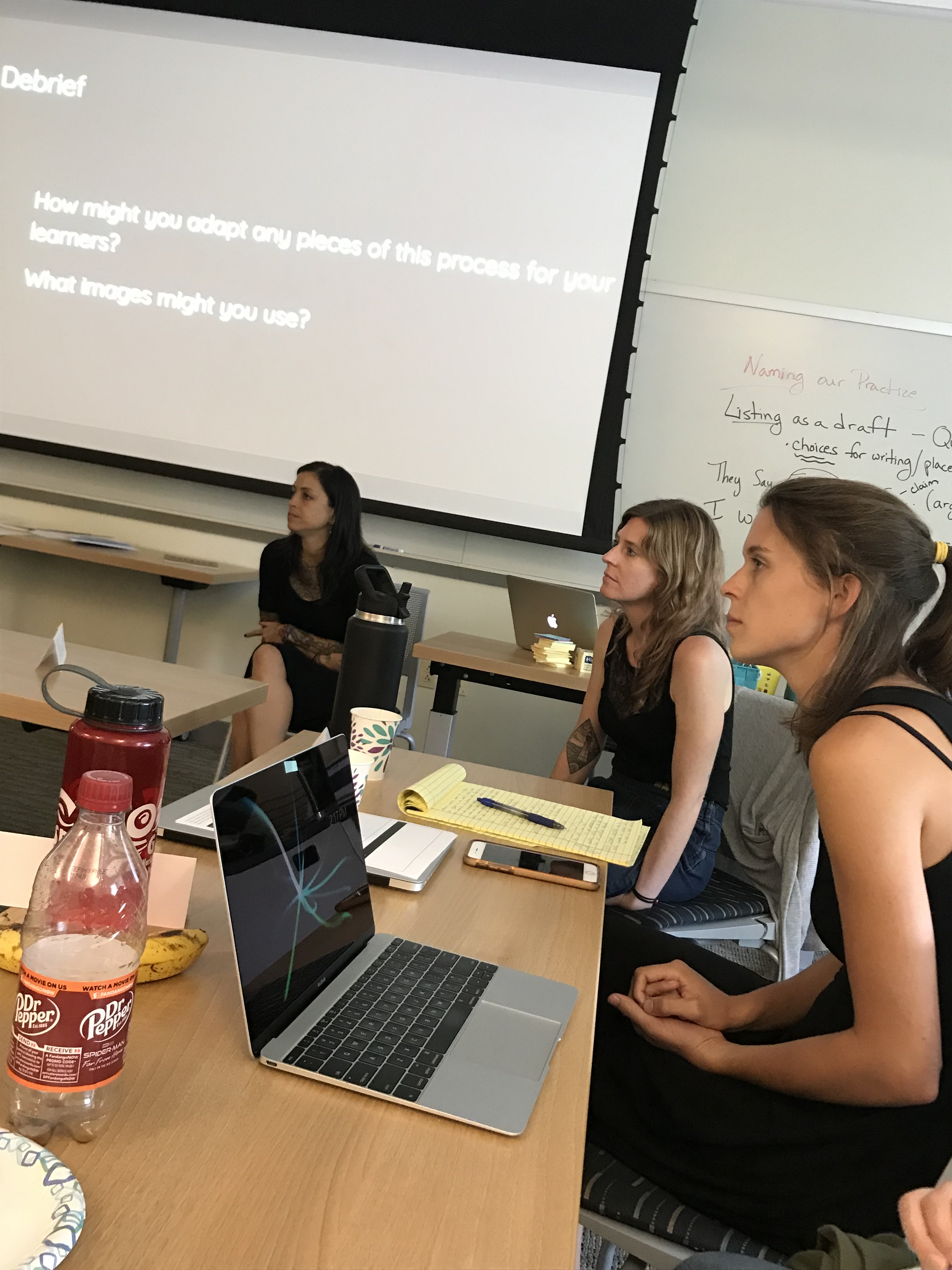
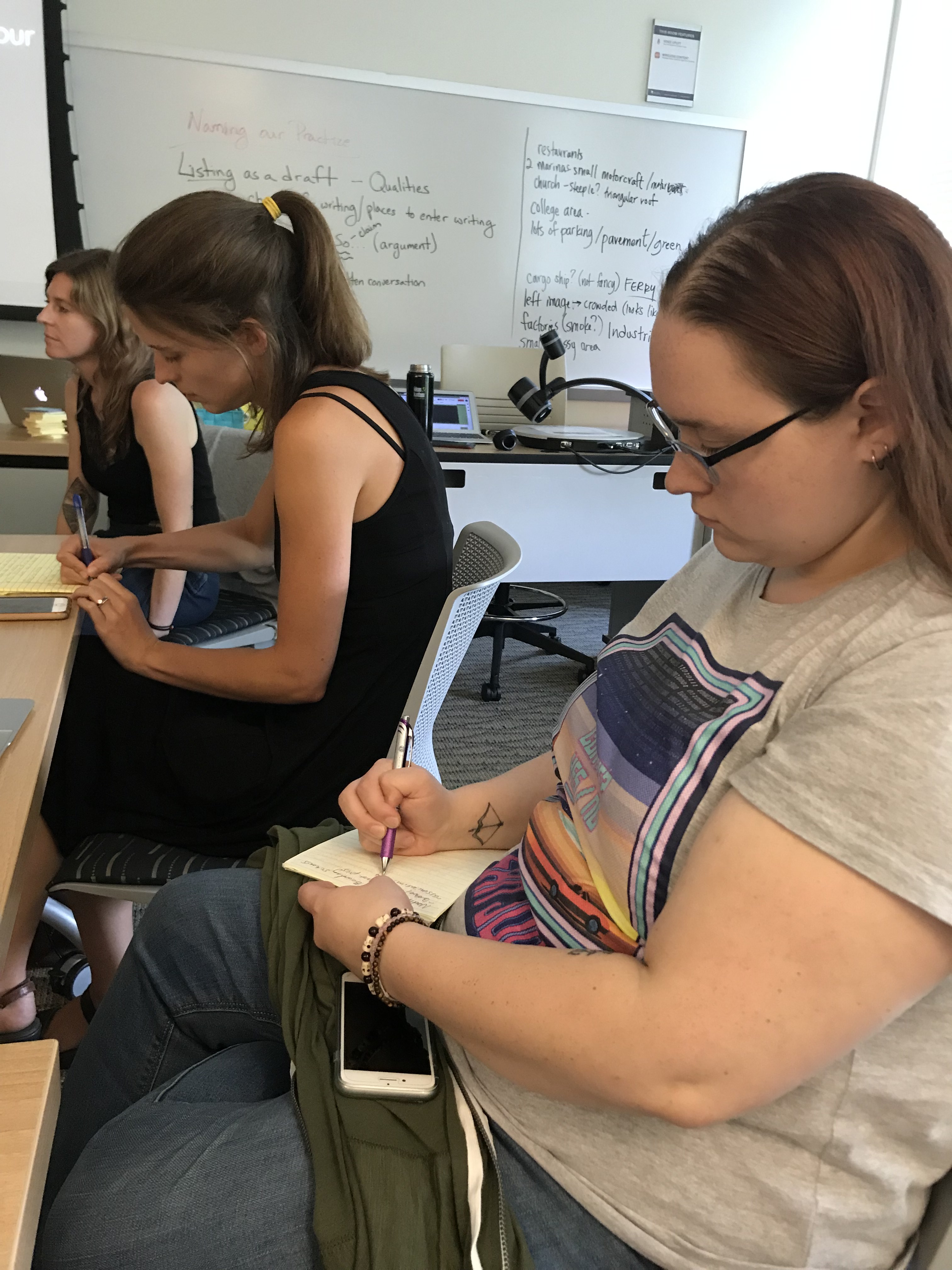
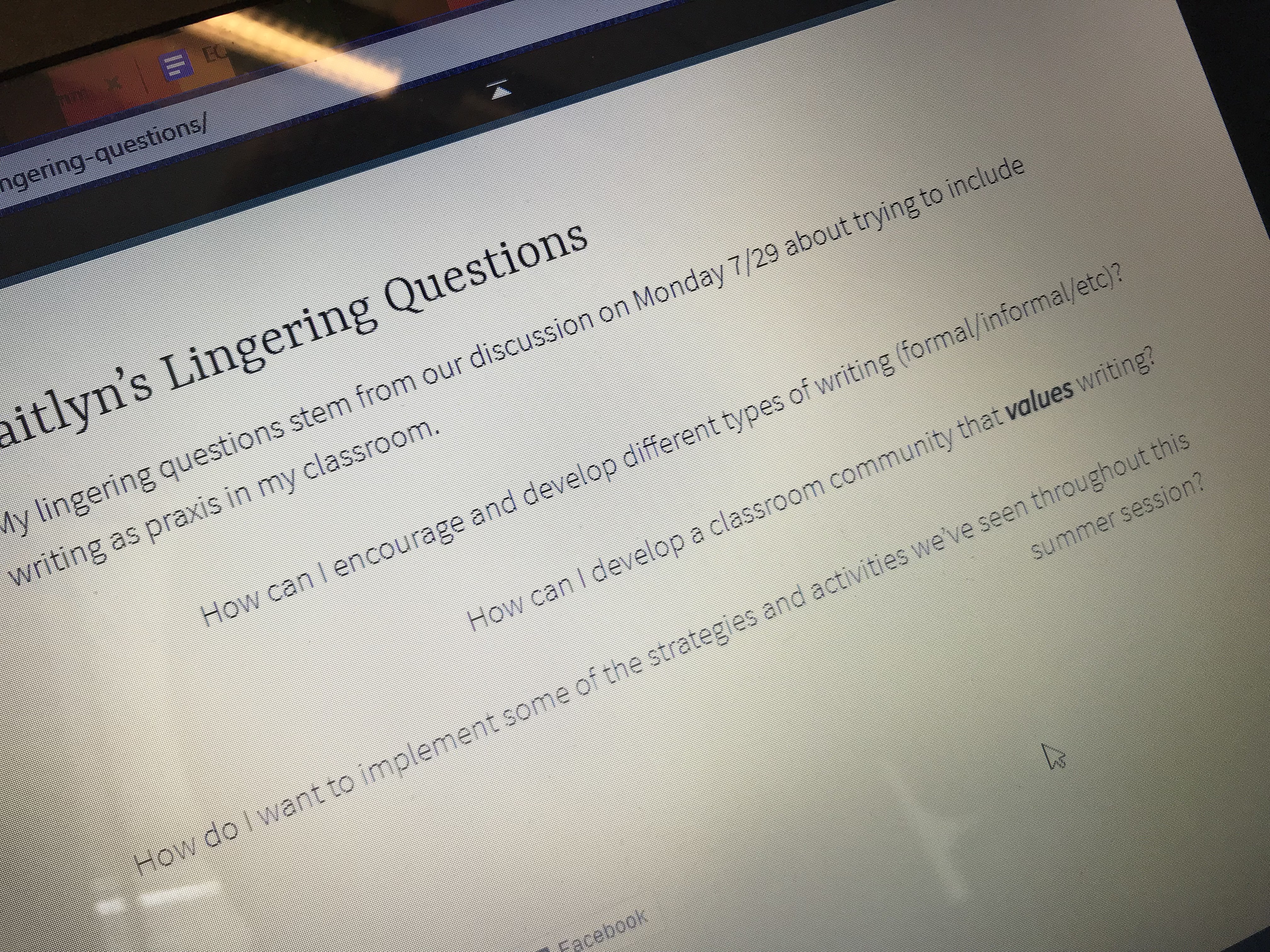
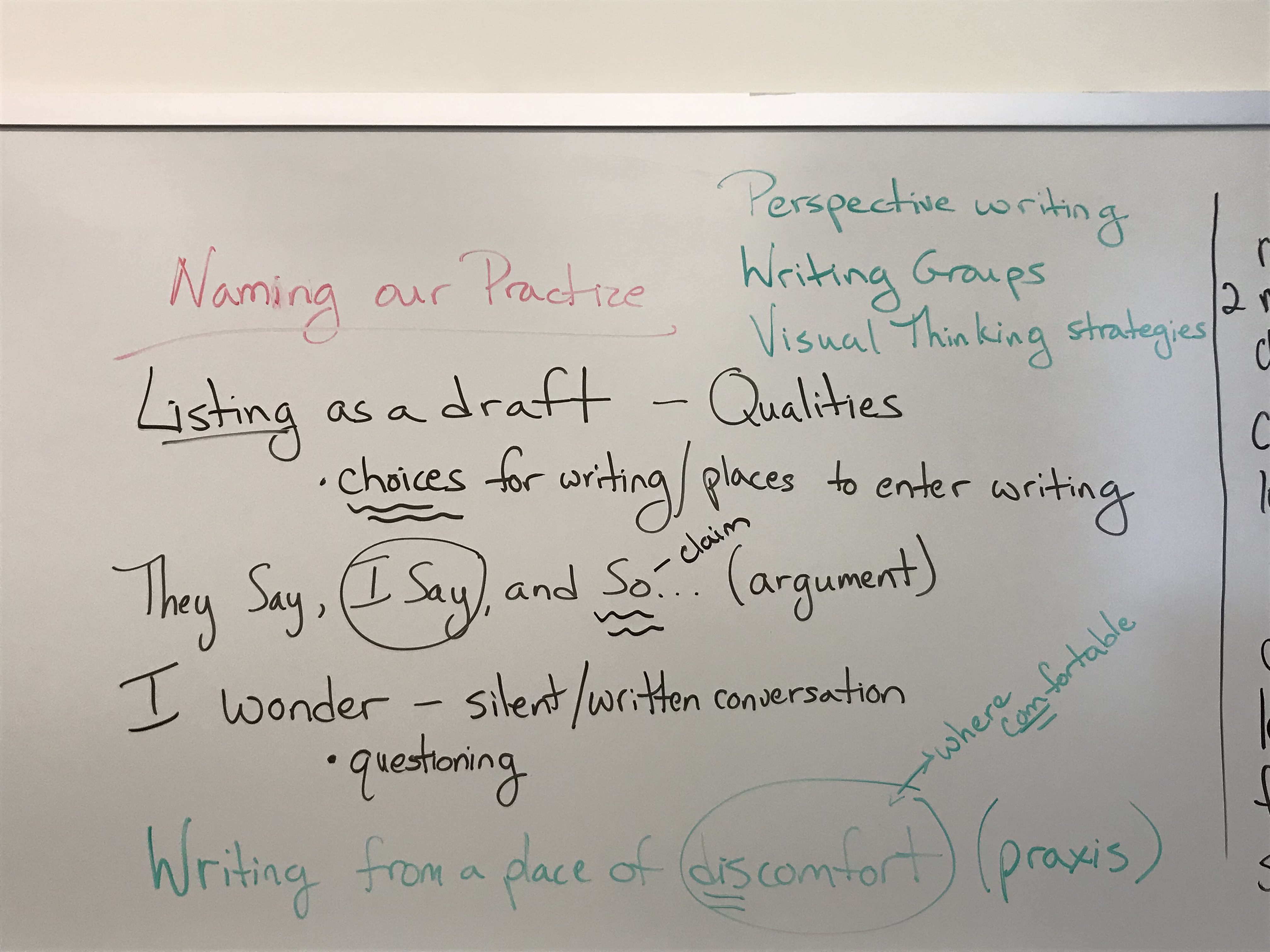
Day 5: Monday, July 29th, 2019
Week two – ready, set, go! Full disclosure: this is a partisan reading of day five.

After Terri’s warm welcome, some conversation about the weekend, and a little breakfast, we opened as we always do. Terri invited us to write, this time about our five “best and worst qualities”. Even though I knew what was coming I was still surprised by a couple of the ones I listed: this exercise prompted me to name aspects of my identity that I assume to be fixed and true, yet never really put into words so that I might see them, concrete, on a screen or page. The reading and subsequent prompt asked us to personify a quality and provided me personally with the possibility of writing about it from a safe distance. (I chose not to: writing about a positive quality felt so rare and affirming. I feel like this experience helped me, perhaps incrementally, reframe my idea of myself. For that I am appreciative!)
I’m also noticing that many of our writing prompts call for us to show up as fully human, asking us to consider parts of our experience that we may never actively reflect upon, let alone think through in writing, let alone share about in a group of colleagues. Each day I feel empowered to tackle the prompt in the way that seems right for me at that moment, and so I feel like writing into the day and sharing our writing reflects our community agreement “challenge by choice” (the language Dan so generously offered on our first day).
We then read aloud our writing about qualities — persistence, passion, perseverance, and more — and found connections among them. There was discussion of an array of applications (teaching personification, characterization, close reading, idea development), which is, of course, essential. But the most moving moment for me was when Chrysanthe shared her reflection on empathy and the moments thereafter. Sam jumped in: “I chose empathy as well. I’m noticing a lot of connections among the qualities we chose. I wonder if these might be windows into why we chose teaching.” I’m just going to leave that right there. I wonder that too. And now I’m wondering if the “why” of teaching is sometimes more important for us to attend to, at first, than the “what“. I’m holding that question in mind.


Sierra then hijacked the morning and provided exactly what was needed: a deck of writing prompts, news of her birthday over the weekend, and the idea of a group chat, which lit up the room.
After a harmonized rendition of “Happy Birthday” there was limited debate about the best medium for the messages: WhatsApp (one vote) lost out to iMessages (everyone else). The medium we use to compose and communicate, it seems, matters. For the record, the first message was “yo yo yo homeslices” (see photo; names removed to protect anonymity). That’s where the groupchat name “Slices of Home” came from. Six months from now, you will have forgotten that. But is it recorded here, forever, because…internet. You’re welcome.
I’m realizing now that this episode of digital sighting might be a bit lengthy so I’ll try to cut to the quick.
Yagelski. Geez.
In all seriousness, Terri introduced the “I wonder” strategy which had us not talking about Yagelski’s provocative article but writing collaboratively (and silently) about our questions about it. Geez. Then, after brief spirited conversation, we were at it again. Charting on paper our selected quotes from Yagelski, jotting our interpretations, and tracing out the implications (They Say, I Say, ..and so...). All, again, silently and in writing. Geez.
Insert passionate conversation about practice here:


It’s difficult to convey what happened across the 45 minutes or so that followed, but there was intense conversation about the applications and implications of Yagelski’s claims: that writing could be a vehicle for exploring and understanding our experiences of the world (200); transforming ourselves (196); achieving happiness and well-being, and improving human life (193); and, ultimately, that the experience of writing could supersede the importance of the text being written (202).
Conversation ranged across both the possibility and challenge of these claims about writing, and had us discussing the wide-ranging implications for instructional content, pedagogy, assessment, and teacher evaluation (by both administrator and the community). Nevertheless, many of us have already felt the power of the approaches to teaching writing espoused by Yagelski: Sam shared her experiences of modeling meaningful writing for students, I recalled my experience of receiving meaningful feedback on my writing, Lisa offered her approaches to teaching literacy for enjoyment in early childhood, and Caitlyn named both the tensions and inspiration inherent in teaching writing as praxis.
The remainder of the day was reserved for working on our community project. In the evening, thunderstorms and flash flood warnings dotted the region. Hope everyone made it home safely.
This was the shortest day of ECLI I. And this is the longest entry in our digital citing. You’re welcome. 😉
-Chris
Day 4: Thursday, July 25th, 2019

I observed that we put careful thought into captions for our items and into where each item was placed.
What a day! We kicked off the last day of week 1 by sharing our Writer’s Museums- a personalized collection of items that we believe define us as writers. As we explored each Museum, we found that we wanted to spend more time with the texts. Ultimately, we decided to leave the Museums up throughout the day so that we could revisit them when possible.

We left comments and wonderings on post-it notes as we explored each Writer’s Museum.
After exploring each Museum, we came together to discuss the process. Many of us agreed that the Museums were “intense” but “intimate”. I listened to Chris as he explained that “sitting with [our] handwriting” was a powerful way to get a sense of our ‘writer selves’. I heard how Lisa was struck by what previous works each of us had saved and felt important enough to share.

We continued the day with a Teacher Inquiry Workshop using found poetry to connect nonfiction. During the workshop, each of us crafted a found poem using the words from an excerpt of Unbroken by Laura Hillenbrand. I connected with what Caitlyn said about how the process of creating the found poem “sucked [us] in”, not just into the activity but also into the text. The discussion circled productively around how creative it was to turn evidence and claim building into a found poem. In explaining how the poem I crafted felt just like one I would write with my own words, Terri helpfully suggested that it was a way to “find voice through other people’s words”.

After lunch we took some air time to work on writing to share later. Then, honoring Peter Elbow, we shared our writing using the Author’s Chair in a non-evaluative, non-judgemental space. I felt that we all found this to be a powerful and even validating experience. I heard Dan point out how he picked up on different things when he heard the piece read in the author’s voice as compared to when he read the piece at the author’s Museum.
The discussion that resulted from this inquiry on the Author’s Chair veered into our wondering of why we don’t encourage students to use the “I” more. I concurred with Chrysanthe when I heard her say that it can be “powerful” letting students use the “I” in their writing.
We summed up the day by naming our practice and reflecting on the many things we’ve done over the past two days. To sum up this post I think it might be best to use a very applicable quote I first heard today: “Writing, to me, is simply thinking through my fingers”. (Thanks for that quote Terri!)
-Sierra
Day 3: Wednesday, July 24, 2019
We began the day with a lovely breakfast and a “Poetry Explosion” activity. This activity helped connect us as a group, and provided us with ideas of how we could meaningfully utilize this activity in our own classrooms.
Val Hughes led an inquiry based workshop on: “A Spectrum of Argument”, we had the opportunity to act as students and experience an activity focused on “argument”, from their perspective.
The sun was shining as we enjoyed a lovely lunch period while sharing our writing pieces in our writing groups.:)
After lunch we participated in a workshop focused on “Translanguaging”. In this workshop we realized how helpful it can be for the student (and teacher), when the student’s home language and the English language is made available to them when completing assignments. We watched a video clip of the song from “Frozen”, in different languages as well.:)
The “Metaphor” activity was the final activity we participated in today. We had to choose between two concepts (ie: river or ocean), and then were asked to explain why we chose one. It was a helpful for self reflection.:)


Day 1: July 22, 2019
We began the day with breakfast and small talk, had lunch while chatting about teaching, hiking and horoscopes and in between meals we participated in activities and conversations revolving around our lives as teachers and writers. We were actively involved in constructivist learning, while studying Faulk’s chapter “Teaching the Way Children Learn”. My biggest take away from our first day is that we are clearly in a supportive environment where we will not only be learning about ourselves as writers and teachers, but we will also be gaining insights into other helpful teaching practices as well.


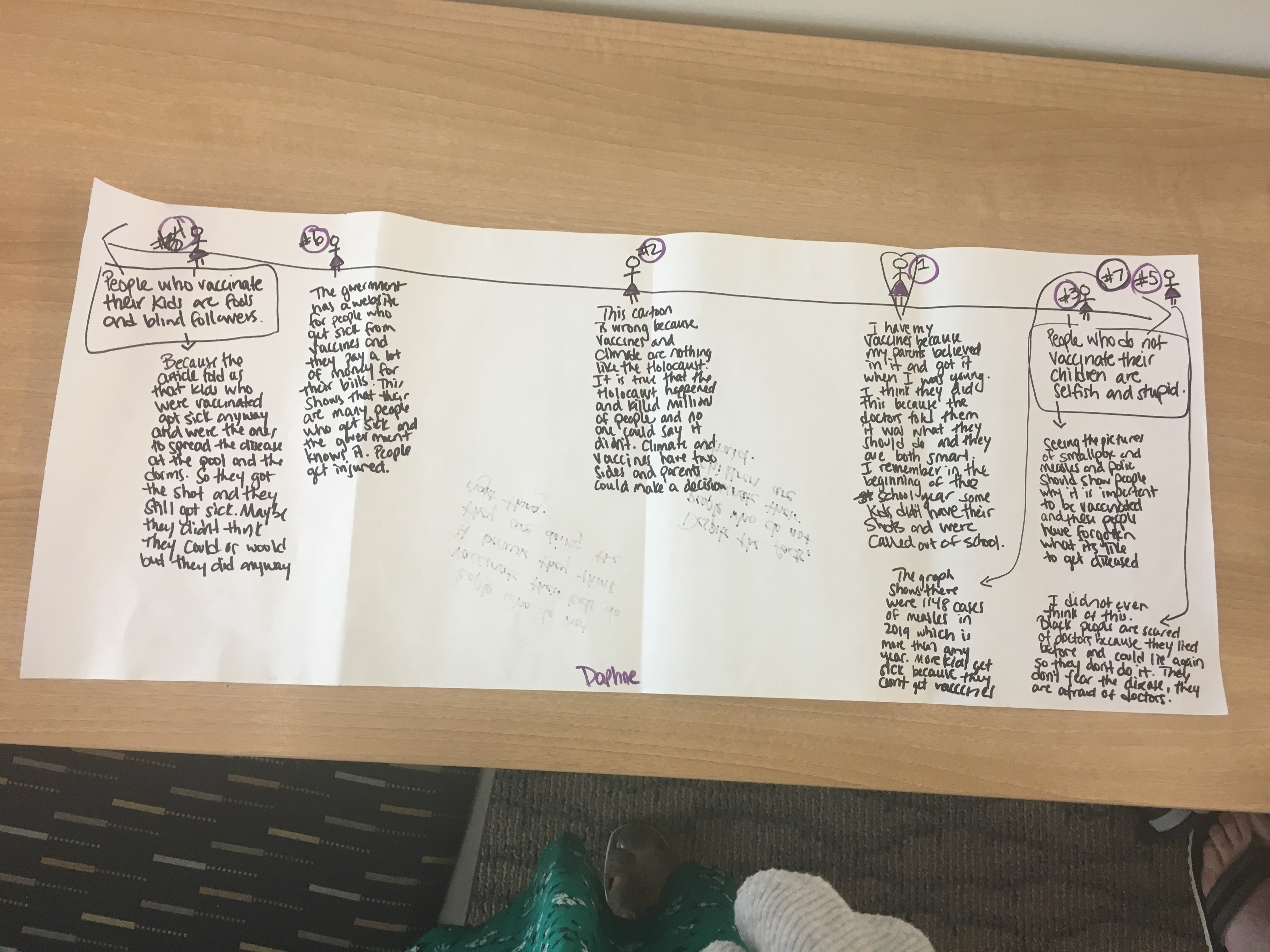
The three images above include how we summed up our biggest take aways from the quotes in chapter 2 of Beverly Faulk’s book. – Lisa
Day 2: July 23, 2019
Well, the agenda seems like a natural place to begin.

I was touched by the “we believe” responses we did on Day 1, so I’ll recap the day with some “we believe” statements. (NOTE: I originally wanted to change “We believe” to “I feel that we believe” in order to acknowledge the inherent subjectivity of my claims, but it looked clunky. So take this note as acknowledging my inherent subjectivity and inability to say the absolute truth about what WE believe.)
Letters!


We believe that the ECLI will provoke a positive and enduring change in both (a) our teaching of reading and writing and (b) how we view ourselves as readers and writers.
Why We Write
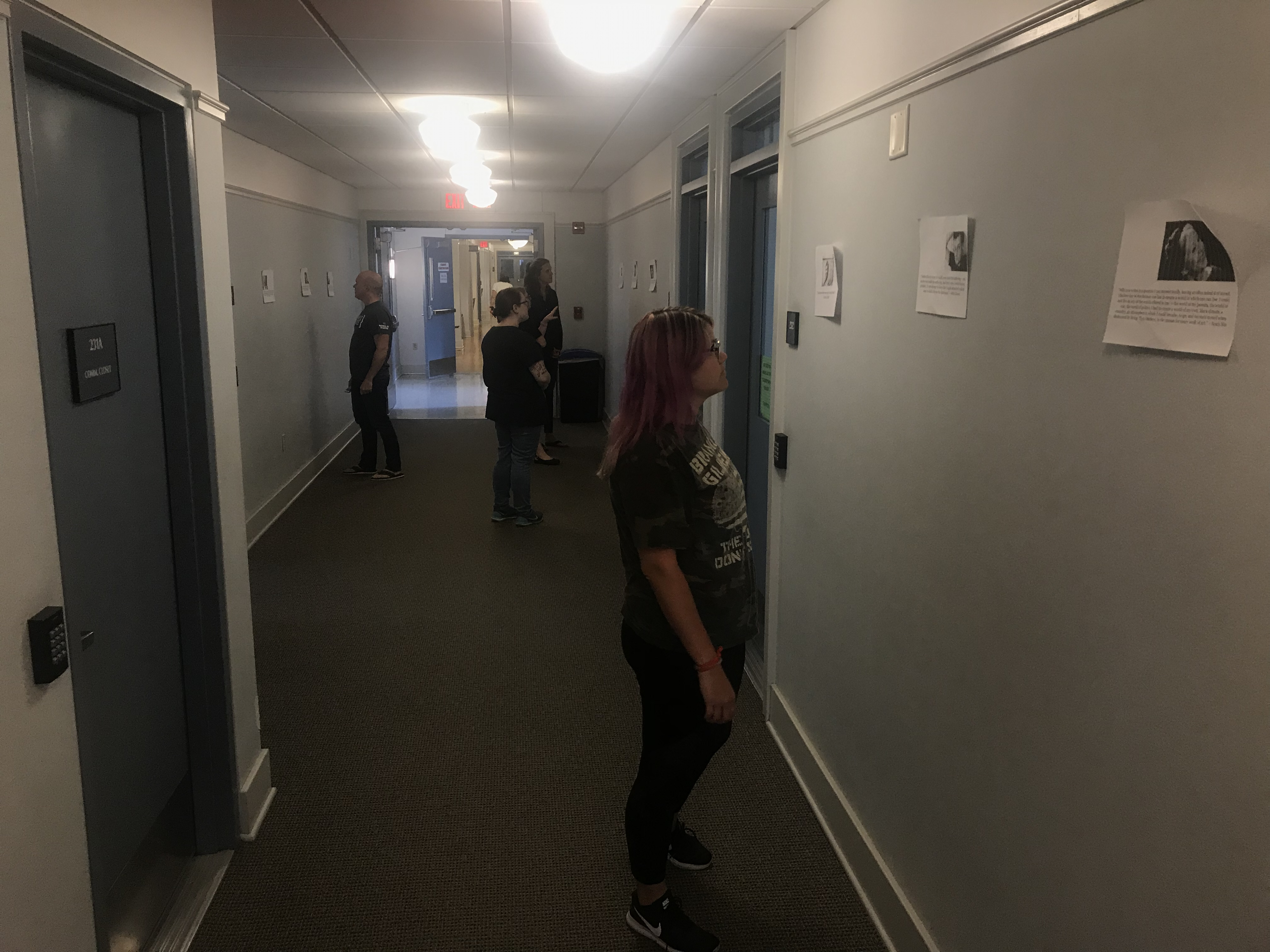
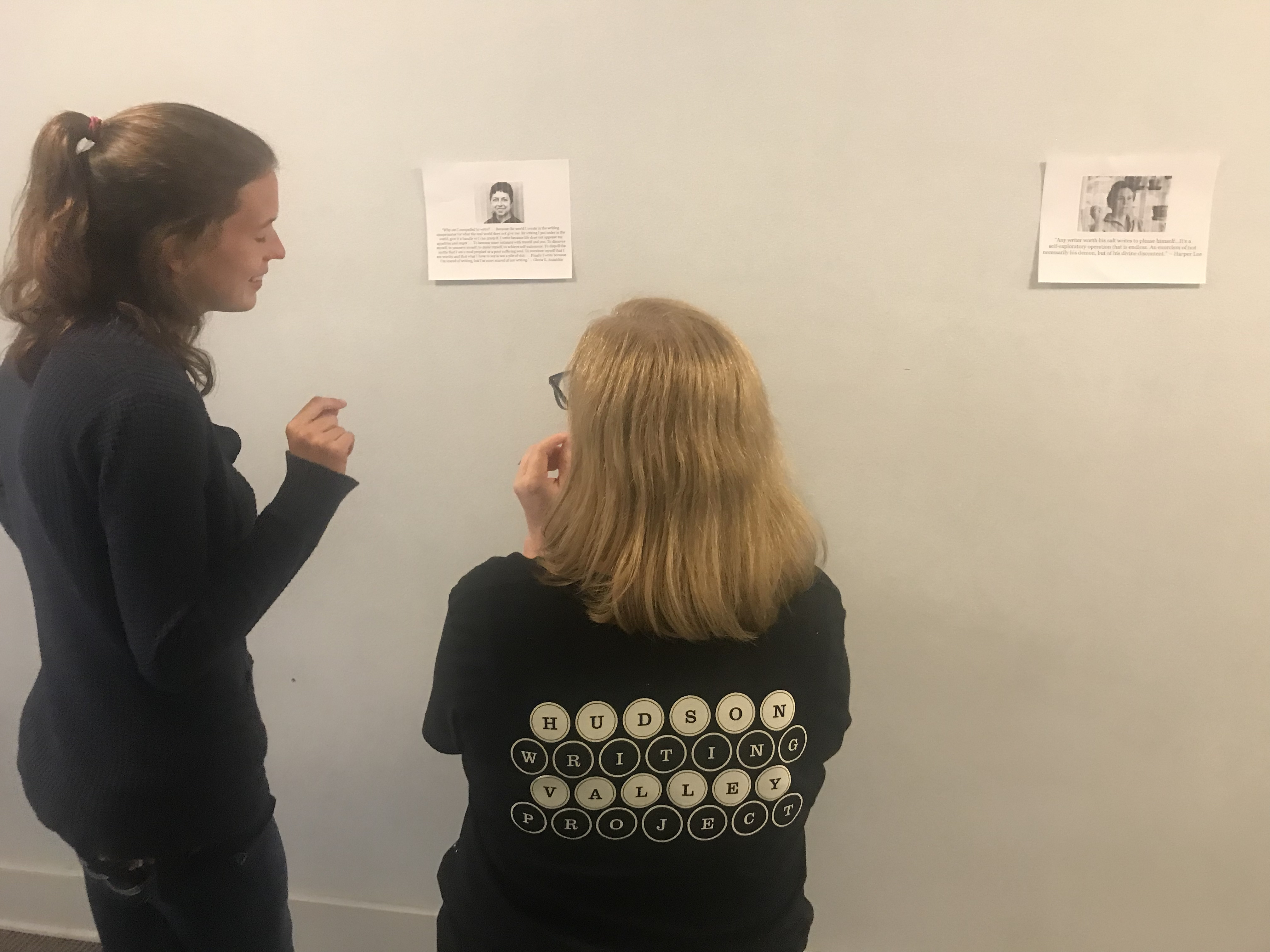
We believe that writing has a beautiful multitude of purposes and audiences and that these purposes and audiences should be embraced and encouraged in the classroom.
Why Students Write (Elbow)
We believe that holistic grading is a necessary evil and that we should explore alternative modes of evaluation in our teaching practices in order to bring out the best in our students. (In fact, this ties into “Why We Write,” as alternative modes of evaluation are better suited for embracing the multiple purposes and audiences for writing.)
Random Autobiography
Admittedly, I’m not sure what we believe about this. I will say that I found the experience of “writing for me” to be powerfully positive, and I look forward to sharing my poem with my writing group!
Design Thinking

We believe that students are wondrously complex creatures and that we should go to great lengths to discover our students’ “ideal” and tailor our teaching practices to meet it.
On an even more important note, WELCOME CAITLYN AND SAMANTHA! WE’RE SO GLAD YOU WERE BOTH ABLE TO JOIN OUR BURGEONING COMMUNITY. WE EMBRACE YOU WITH OPEN ARMS.
…and to “put a pin in it” (see one theory for the etymology of this phrase here) I’d like to close with a beautiful picture I snapped at sunset while on the “River to Ridge Trail,” which connects New Paltz to the Mohonk Preserve.

And I’d also like to let you know that about 20 minutes before snapping this picture a bee stung my foot. It was my first bee sting. That bastard. – Dan
 ECLInstitute - HVWP 2019-2020