Blog Feed

Digital Citing November 2nd

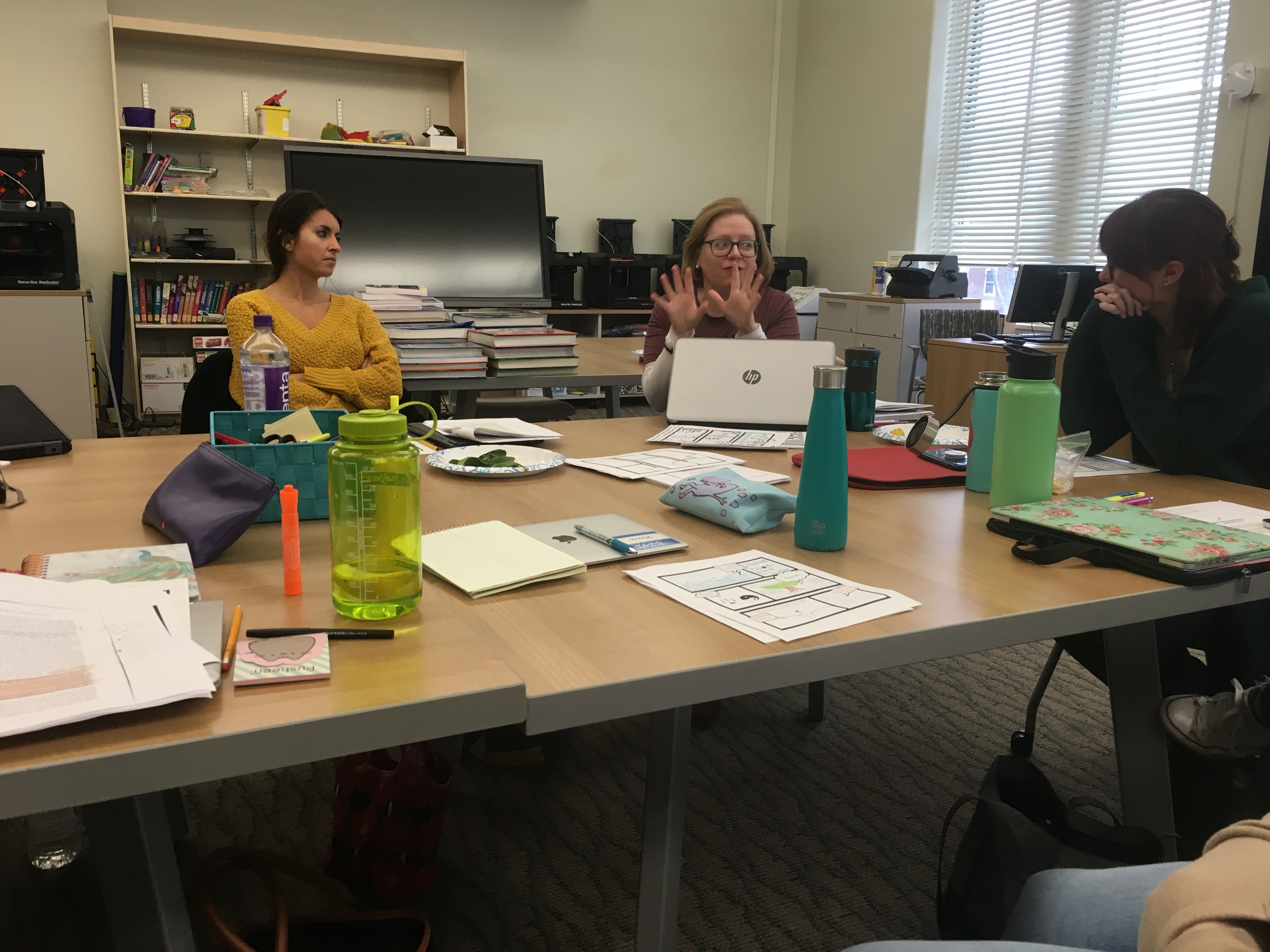
Once upon a time, six little bears sat around the table as their three teachers bears got settled. We began the day by one teacher bear, Julia having us writing into the morning by writing about the first time that we had been to a place. We, little bears, were to focus on the sensory details that we remembered about being in that place for the first time. Each of the bears, teachers and students alike wrote furiously about the first time they had been to a place. After our time was up, each bear shared a small excerpt from their writing.

Then one brave little bear, Caitlyn, shared out her digital citing from the previous session. Sadly the little bear author of this post was not present, so I listened enraptured by little bear Caitlyn’s recitation of the previous meeting.

After little bear Caitlyn’s digital citings, we six little bears and three big bears read over big bear Terri’s assignment on Poe’s stories and irony. We looked at a student’s writing where they read several of Poe’s stories but the endings were cut off. The students then had to write an ironic ending to the story. We bears, big and little, discussed what we noticed in the writing and pointed out the strengths, areas of improvement, and next steps in the assignment.

We, little bears and three of the big bears, spread out around the room and set up stations to showcase student work from our inquiry projects. Then all the bears went around the room and left comments on sticky notes on each other’s work to comment on what we noticed and what we wondered about each of our exhibits. Once we had all left feedback and had a time to review it, we came together as a big bear group and reflected on the carousel activity.

Then big bear, Julia, got up and showed us her inquiry blog post about her RAFT assignment that she had given to her classes. She walked us through the outline and what steps she had taken when she conducted her inquiry. Big bear Terri then made a list of all the necessary components for us little bears inquiry posts for next session.

All the bears came together again around the table to watch a Ted talk about gratitude. After the Ted talk, we wrote about gratitude as our writing out for the day. After we spent some time with our writing, the bears took turns sharing our snippets of what we are grateful for. With our gratitude writing shared, we closed out our session and prepared for our next meeting on December 7th.

Digital Citing for January 25th


After a long break, the gang was reunited on January 25th. Eager to catch up, we ate some tasty breakfast provided by Terri and Chris and got down to how our new year was going.

Discussing


We began our day with a bit of venting and reevaluating the darkness in our lives through the writing into the morning activity, “Writing From a Place of Darkness.” The first part of our writing reflected the dreary weather outside, while during the second half, we revisioned bringing light back into the situation.


After some important announcements, we all got comfy and read “Tempered Radicals” using doodle notes to help solidify the most important aspects of the article, or to Sam and Caitlyn readingrepresent the questions we had. Conversation then ensued about whether or not being a Tempered Radical was a realistic way to make a change or not in Education.  In the end, the group decided that we could all be considered Tempered Radicals.

The theme of drawing to think continued after lunch when we took the time to draw maps of our schools and identify “allies” and “blockers” in our school community. Our papers were an array of green and red. 

Chris introduced a “Heuristic Model” close reading strategy and led us to think about the “Interactional Leadership” infographic. We began to think more deeply about the cyclical nature of the action for change and how we might initiate change in our buildings and step into leadership roles as educators.

As our brains began to percolate possible leadership projects, we used our Heuristic notes to discuss the different discourse moves necessary when approaching others with our goals.

Finally, Lisa's allies and blockersAt the end of the day, we had fun practicing how to navigate changing the minds of our “blockers” using the sentence stems in the Interactional Leadership infographic.  Not only were we entertained, but we also practiced valuable discourse moves through role-playing.   Chrysanthe and Dan acting

October 21st, 2019 – Digital Citing

Disclaimer: I was feverish during our last session, so if my details are off please forgive me. 

Here is what we accomplished: 

  • Start
  • Writing Into the Day – InstaPoem
  • Teacher Inquiry Discussion
  • Entering the Parlor (Research) 
  • Reflecting (on Research) & Annotation Activity
  • Naming Our Practice  
Later we would learn that Daniel overslept his alarm, so we were relieved to hear from him when he awoke from his slumber. 

On a chilly but beautiful fall morning, ECLI was once again in session. We spent a larger chunk of the morning (somewhat stalling for Dan) catching up and sharing our lives. Lisa, Sierra, Terri, Julia, Chris and myself talked about our lives, our classrooms, and future plans. It was so pleasant  to have Terri and Julia back in action, we missed them during the last session. Our morning discussion surrounded the conference both Terri and Sierra attended earlier in the week, general catching up, and work related discussion. All which welcomed and lovingly had. Sadly, we were missing Chrysanthe and Sam for this session, while Dan was MIA but nearby. 

When we actually started the day with an interesting “InstaPoem” for our Writing into the day. After composing our poems (ON PAPER!), we all shared what we wrote. Lisa’s poem echoed the triumphant saving of an innocent spider.  I wrote about volleyball, because it consumes my life. Sierra’s (self-proclaimed) “dark” and eloquent poem was well-written and beautiful as always. Chris wrote passionately of his illness in such a descriptive and concise way. As Sierra put it, he is very quotable

Terri’s nature poem about her previous weekend in the woods, really made me want to go camping. Last but certainly not least, Julia’s poem surrounding energy had a really interesting vibe. The experience was easy but inspiring, another great writing strategy for our classrooms. These activities are some of my favorite, to see how differently we interpret the same exercise, I love how my peers write and think. 

Once we completed our sharing, we shifted gears to our next activity. We discussed “why” we do something vs. “what do you do” with a short video. This shifted the discussion to the “why” associated with our teacher inquiry. 

Terri started the discussion off with what motivated her teacher-inquiry. She said, so many people around her find value in what she is doing, even when she struggles with it. Since she doesn’t always feel this way, her goal was to focus on how to create a culture of support to support literacy and writing. Her inquiry project aims to focus on creating teacher-writing groups at her job in hopes to empower teacher. 

Lisa spoke next about her struggles with ELL learners. She talked about the delicate balance between necessary curriculum and making learning fun. “I can’t be bored and they can’t be bored. I don’t know the best way to teach English, at all.” I think all teachers struggle with how to make learning engaging and including all the necessary skills/elements. Chris reminded her of her beautifully illustrated children’s book from our summer session and the possibility of connecting it within her lessons. Lisa mentioned also wanted to include and find texts that meet the students where they are. It was a very productive and support discussion. 

Sierra’s focus revolved around students value writing and wanting to write more. Her inquiry and mine focus on implementing Writing Groups into our classrooms. Although Chris was sickly, he still contributed to the insightful question — “why writing groups?” Sierra responded that she found in her writing groups in ECLI, other people such as myself found value in her writing. She wanted to use these experiences in her own classrooms to help students writing, hopefully in a similar way. Once more, together we brainstormed suggestions, modifications, and methods of potentially approaching writing groups in her classroom. Chris pushed the idea of WHY – “why is that so compelling? Writing together and sharing our writing. WHY collaborative writing or writing together?” We discussed, working in pairs, not implementing it into every classroom, and that teacher inquiry is an EXPERIMENT. This mirrored my own thoughts and motivations, because my inquiry questions were the same, how can I implement writing groups (successfully) in my middle school classes? Chris contributed his thoughts on his inquiry, being the WHY. 

RESEARCH, RESEARCH, and more RESEARCH. After figuring out why we wanted to focus on these various topics, we had time to research. Sierra and I collaborated on writing groups, and brainstormed different ways we could introduce this idea in our very different classrooms. This time was very valuable to see what others were saying about our topics. 

Lisa dressed as a VSCO girl, JUST FOR ME. Sadly, no pictures were taken to document this glorious event. She was gracious enough to share her scrunchies with me, as I cringed at her “sksksks” sounds. 

Lisa left us around noon, but her and I discussed the excitement over the “One Positive” and texting in the group chat. I was once again triggered by the final chat I overheard between our instructors on Lisa’s VSCO “costume”. 

The session began coming to a close with some final activities. We wrote a reflection on our research using some guided questions and thoughts. We discussed our thoughts, how we felt, what we learned and much more. Using this reflection, we then moved to an annotation activity. The first round, we asked questions on another person’s reflection. Then commented on yet another, and lastly made a connections on a third. We returned to our own reflection and read the comments, which I loved. I force my 8th graders to annotate, so for me to do it in my own classes makes me chuckle. They think I torture them for fun, when it’s a great strategy for any type of reading. 

Last but not least, we made a plan of action. What’s next? What needed to happen between 10/19 and our next session on 11/2? We outlined what we needed and wanted to do to be ready for our next session. Before ending for the day, we named our practice (see above). Chris thought it was cute, to include “SKSKSKSK” as part of naming our practice. He must have been sick, or enjoys torturing my soul. On that note, I was ready to leave and head home to try and sleep off my fever. I am eager to see our missing counterparts next session. 

Ps. I apologize for not documenting the wildness of Daniel in this session. I was definitely off my game. 

Digital Sighting for September 21

ECLI II: Engaging in Reflective Practice
Session 1

At the beginning of the school year I often feel like a little kid. Nervous, anxious, exhilarated . . . and looking around for familiar faces and smiles. Our September session felt like that for me: it was so great to see everyone enter the room, one by one, brimming with stories from the first three weeks of school. And there were so. Many. Smiles.

We missed your smile, Terri, but your presence filled the room as we gathered around for a little storytime readaloud and indulged in some time to listen, notice, imagine, and dream a bit. We began with a read aloud of Kobi Yamada’s “What do you do with an idea?” Thank you for sharing this book with us! Idea__49764.1521585130

As we read, we practiced some basic, yet essential, noticing and close reading strategies: multiple rounds of describing and inferring about a book cover; reading character illustrations to describe character actions; inferring character motivations from character actions; and using a motif to reflect on one’s own experience. I didn’t realize until I returned to our powerpoint exactly how deep into inquiry those brief prompts — and this seemingly simple text — impelled us.

51xpZ5KoFWLAcross the course of pages, I recall Sierra exclaiming as she noticed the activity of additional eggs and crowns, Lisa pointing us toward the progressions of color, and Sam teasing out the implications of the boy’s relationship with his idea. We are an animated group — but this activity brought the kinds of smiles that we often see on the face of young kiddos, enthralled with an introduction to a magical world. We continued, reading for secondary details in order to open up our understanding of complex pages, and closed by applying our questioning to a new inquiry: “What can teachers’ ideas change?” But while there was rich noticing, describing, conversation, analysis, and inquiry, I was struck by how light and enjoyable this portion of our day was. I wonder: could I offer experiences like this to my students? What would a weekly read aloud do for our community?

It felt as if we had gathered around a primary school rug for reading time, and I felt some reluctance to breaking away to consider these questions: What is a current challenge in your classroom? And what ideas come to mind as you think through how to address it. We wrote for a little while and really got into the depth of our classroom work this year.

Caitlyn kicked us off: “I’ve got a weird thought!” She proceeded to tell us about her student Dylan and his group of friends. One day he dropped off a notebook, which Caitlyn opened to reveal a thoroughly developed, outlined plan for an arcade. This brought to mind the importance of connecting with our students over their own curiosities and their hidden writing lives. I remember Lisa jumping in, wryly, quoting the book from the morning: “Some people thought the idea was weird!” Sam’s spoke of a student who wanted to invent a new school and the power of validating student curiosities and ideas — because they seldom have the confidence to realize how awesome their ideas actually are.

Conversation quickly turned to the group chat, a key innovation in this year’s ECLI (THANK YOU SIERRA!), and the power of reading one anothers’ words on the first day of school and across the month. I’m including this recollection as a reminder to self (and maybe everyone else, too): it helps, so so much, to remain connected. Because, all agreed, no one who is not in teaching really gets it. There was broad consensus here: being amongst teachers, and this group of early career teachers, helps in so many ways.

For the next activity, we weren’t composing with pens, paper, or laptops, but with magazines, scissors, glue, and colorful paper. This made me wonder what composing with images could do to spur deep reflection in class — because everyone seemed to be tackling complex issues but communicating them clearly through collage. Caitlyn asked: so what does this look like across grade levels? I don’t know that we answered that question, but perhaps we could circle back to it.

We shared our collages about problems and ideas: Caitlyn discussed the difficulty of lesson pacing in a 55 minute block, Sam wondered aloud about her fear of initiating the author’s chair practice (‘will they enjoy it?’, ‘what will happen’?), Lisa wondered through how to make literacy learning fun when students had little English language and cannot read, Sierra wondered about the relationship between revealing her love for writing to students feelings about writing. We kicked around all kinds of ideas for the next period of time, and as Dan arrived (yay, Dan!) really under the weather but no less effervescent than always, we broke for a snack.

I am realizing now that this digital sighting may get really long if I keep going at this pace!

After our break, we reviewed ECLI II and our focus on teacher inquiry into student learning. We then turned toward teacher fingerprints, those indelible yet ever evolving identities comprised of our hopes, motivations, inspirations, and so much more. We looked at some samples, continuing our practice of looking at mentor texts written by learners — in this case, written by teacher-learners who had written these in HVWP institutes. We took some time to write our own, and shared golden lines all around. I can’t wait to read everyone’s completed fingerprint — make sure to link yours on our blog if you haven’t yet done so! These will be so much fun to share and chat about.

At that point, our special guest arrived (earlier in the day Caitlyn nearly screamed, with excitement, “I KNOW WHO IT IS!”): Alex from last year’s ECLI. He spoke with grace about the process of writing the fingerprint (and shared some of his), being in the inquiry project, and participating in the cohort for the year. I’m pretty sure he said that the ECLI was the best professional learning experience of his career — but also made it clear that his inquiry was valuable to him in part because he was intentional with his initial reading about his topic, and that he devoted time to it both in his classroom and when writing it up.

After some conversation, we did a carousel activity with some quotes about inquiry from Dana Yeondl-Hoppy. During this time, we walked around, taking in the opportunity for deepening practice that teacher inquiry affords. One of the most popular quotes was this one: “Teacher inquiry invites intentional, planned reflection, heightening your focus on problem posing…[and is] made public for discussion, sharing, debate, and purposeful educative conversation…As inquiry raises the visibility of teachers’ thinking, the profession garners a new respect for the complexity teaching entails.” There was some agreement about the complexity of teaching and inquiry as a vehicle for making it visible, but one things that rose to the surface was how empowering “raising the visibility of teacher practice” could be.

We ended with some writing, thinking through our next steps: writing inquiry questions and completing our digital footprints. At the very end of the day, we did some dialogue walks in partnerships, which kept us on our feet and got us out into the fresh autumn air.

It’ll be a little colder the next time we meet, but undoubtedly no less vibrant. Can’t wait to see everyone, and continue our semester of inquiry together!

I grew up in Rhinebeck, New York and attended school at SUNY New Paltz. I earned my undergraduate degree in elementary education and my masters is in Humanistic and Multicultural Education. I am currently certified to teach grades B-6 for elementary education and I have my advanced certificate in teaching English as a second language. 

Prior to teaching I coached the town swim team’s eight and under age group and gave swim lessons through the town recreation program. I went on to helping coach my club volleyball team for several years, and coached the Rhinebeck modified volleyball team for one season. I also coached the Newburgh rowing club, where I met my husband and ended up learning about San Miguel Academy, a privately funded middle school for low-come/at-risk youth in Newburgh, NY. I began to working as a weekly chaperone for field trips and then took a full-time teaching position where I taught Humanities to 6th-8thgrade boys. 

After working at SMA for three years I was offered a job teaching a fourth-grade classroom at Dutchess Day School where I worked for three years. I taught fourth grade, third grade and preschool along with teaching several library classes, reading groups for varying grade levels and a science class. 

When I am not teaching I love trail running, hiking, gardening, swimming and relaxing outside with my dogs. I live with my husband in Gardiner, NY. Together, we enjoy traveling to beautiful places and exploring their natural settings while meeting new people from around the world. 

Welcome!

This blog will be a place of welcome, a forum through which we explore writing, learning, and leadership. We will build the website with the goal of documenting and curating our collective journey so that it becomes a resource that we can return to as we take ideas from one learning setting to another.

Please be respectful and take time to read, respond, point to, name, and build on the good ideas that we each share.

Terri and Chris

We welcome you to create new POSTS of your latest work below for sharing and feedback. Also, please scroll down on this page to see your colleagues’ work and respond to it. When you post a piece, please be sure to quickly frame it at the beginning with any necessary information (i.e. what type of feedback you are looking for, etc.) HAVE FUN!